I Went Across the Country to Do Something Hard (On Purpose)

Start of the race, running out of the start tunnel
I voluntarily flew across the country to run eight kilometers, push heavy objects, throw medicine balls at a wall, and question several life choices — all before lunch.
This was my first HYROX race, an endeavor inspired by my friend Beth. We entered as a women’s doubles team.
At the start of the competition, I looked around and realized most of the athletes were significantly younger than me. That part was obvious — the gray hairs, the creaky joints, and the quiet confidence that comes from knowing you’ve survived worse than wall balls.
HYROX bills itself as a “hybrid fitness race,” which is a polite way of saying it combines running and functional fitness in a way that leaves very little room for excuses.
Eight 1-kilometer runs.
Eight fitness stations.
Everyone runs the same course. Only the weights change depending on the division.
No shortcuts.
No hiding.
It sounded ridiculous.
Naturally, I signed up.
Why Doubles Made Sense (Until It Didn’t)
Beth and I have run annual Turkey Trots and completed two Disney half marathons together. We both enjoy being active — but we’re built differently.
She is strong. Years of consistent strength training have made her powerful and steady.
I am a runner. For me, strength training has historically been… negotiable.
On paper, HYROX Doubles seemed perfect. Divide the work. Play to strengths. Balance each other out.
Here’s the catch no one emphasizes enough: both partners have to do all the running. Together. Side by side. Sensors on the course make sure of it. You cannot start a station without your partner, and you cannot run ahead to recover.
Suddenly, teamwork mattered a lot more than we expected.
Training While Raising Teenagers (And Having a Job)
We didn’t train like professional athletes. We trained like working moms of teenagers — which means efficiency mattered more than perfection.
Most weeks included five to six training days, with one or two intentional recovery days. Some weeks, three. I’ve learned the hard way that ignoring fatigue eventually forces you to listen to it louder.
Training included:
- Running (but not endless mileage)
- Burn Boot Camp strength sessions
- Peloton rides when weather or time made running impossible
- Walks with the dogs wearing a weighted vest
- Mobility work focused on ankles, knees, hips, and upper thoracic spine — all critical for wall balls
Recovery days weren’t passive. They included stretching, mobility classes, foam rolling, a Chirp wheel, and a Theragun that became a close personal friend.
Shortly after signing up, we did a one-time drop-in at a local gym offering HYROX-style training. It wasn’t about crushing a workout — it was about learning where we stood. Neither of us had ever touched a SkiErg before. That changed quickly. The sled push and SkiErg humbled us. The farmer’s carry surprised us — in a good way.
We also scheduled a 2:1 session with a HYROX athlete and coach. The biggest benefit wasn’t the workout — it was learning better form for sleds, SkiErg, and the rower, plus honest race-day advice. Helpful? Absolutely. Slightly anxiety-inducing? Also yes.
Race Week, Time Zones, and Eating Like It’s Your Job
The week leading into the race, I focused on carb loading without cutting protein. Hydration was non-negotiable. Electrolytes were daily, especially knowing travel was involved. LMNT became a staple — watermelon flavor tastes like a Jolly Rancher and doesn’t pretend to be subtle.
We flew from North Carolina to Las Vegas the day before the race, completely forgetting about the three-hour time change. That mistake showed up later.
This race allowed Day 1 athletes to check in early at the Puma Flagship store — a luxury compared to the usual 90-minute pre-race check-in window. Timing chip. Bib numbers written on our arms. Wristbands secured. Merch expectations unmet — but that problem solved itself later.
We stocked up on race fuel — water, bananas, bagels, yogurt smoothies, pretzels — rested briefly, walked far too much (25,000 steps), and crashed early.
Race Day: Controlled Chaos

The “IN” arch to the Roxzone – in Vegas, you always entered the second time you “see the IN”
Race day in Las Vegas was electric.
Waves went off every ten minutes. Music thumped. Announcers shouted. Athletes of every age and background moved through the same course. We tracked a Burn Boot Camp trainer we knew on the ROXFIT app so we could find her on course — and surprised her in person during the sandbag lunges. That kind of spectator energy doesn’t exist at a marathon.
The warm-up zone had everything — treadmills, SkiErgs, sleds, wall balls. We practiced handoffs we probably should’ve practiced sooner, then lined up in the start tunnel while an MC counted us down.
We told ourselves not to go out too fast.
We absolutely went out too fast.
The sled push and pull were heavy but manageable. Somewhere between those stations, my partner started to feel unwell. At that point, the race stopped being about time and became about finishing well.
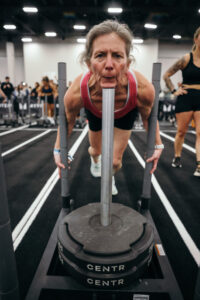
Sled Push- Make sure to get your weight as far forward on the sled.
We slowed. Walked some runs. Adjusted station work so each of us could recover when needed. I took on more burpees and lunges. She carried the load on the farmer’s carry. Water and electrolytes after every station became critical. A single Huma caffeine gel at the halfway point did exactly what it needed to do.

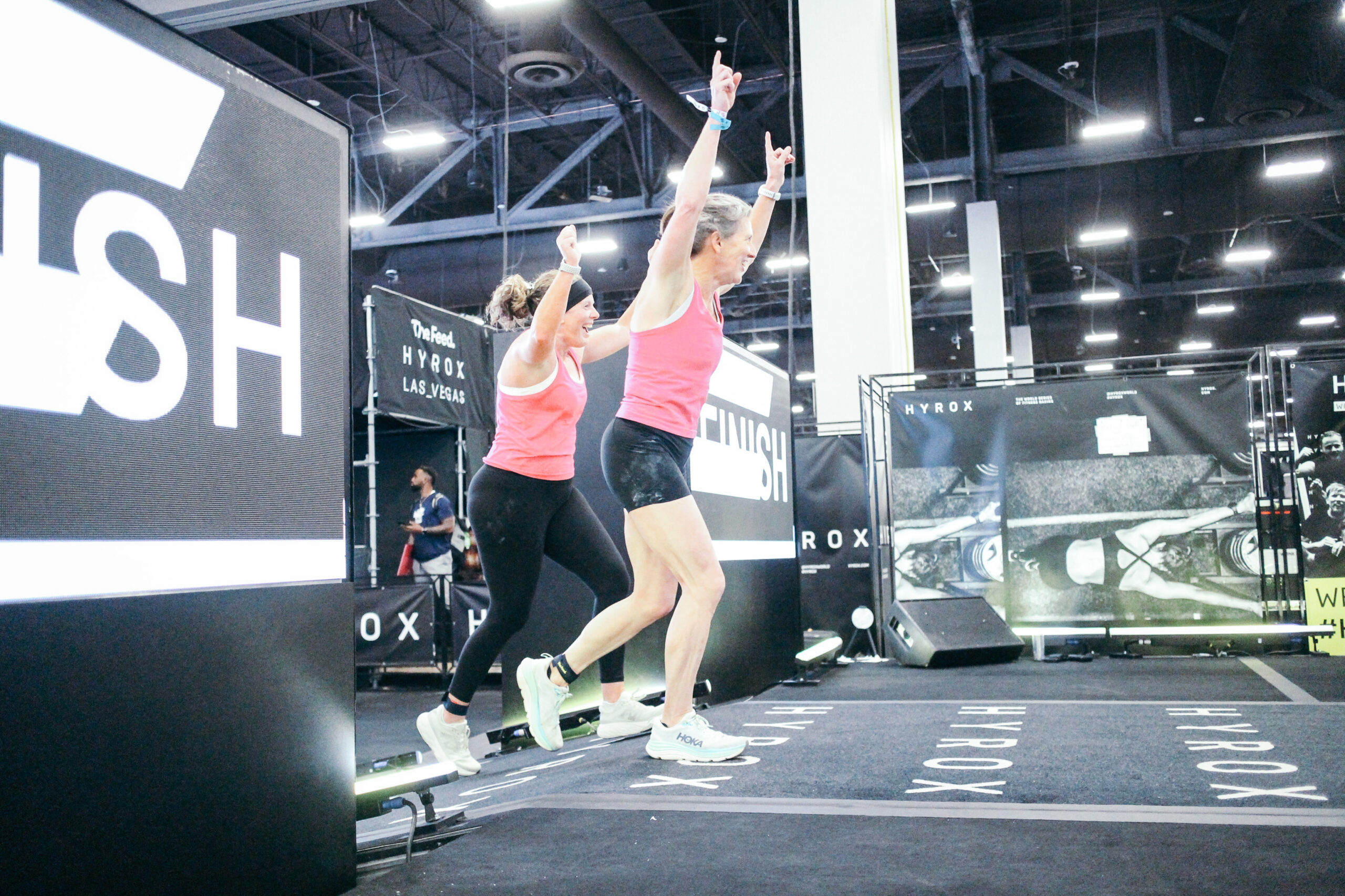
The wall balls were exactly as advertised — humbling. Strict judging. Fatigue. A depth box that felt unnecessary but removed all doubt. When my partner finished the final reps, we sprinted to the finish together.
Time: 1:44:44
No regrets.
Crossing the finishline
What I’d Change (And What I Wouldn’t)
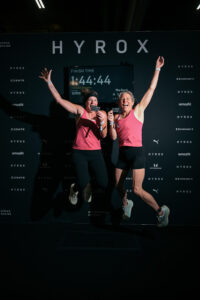
We did it!
I wouldn’t change much.
Running, Burn Boot Camp, and Peloton prepared me well. My longest run was 4.5 miles — not the 6+ miles many recommend — and it was enough. What mattered more was running on tired legs, after strength work, with an elevated heart rate.
If anything, I’d do more run-station combinations and finish more workouts with wall balls.
I would do HYROX again without hesitation. Doubles was the perfect introduction. Singles will be a different beast — and that’s exactly why it’s tempting.
As a 51-year-old racing alongside athletes half my age, I didn’t blend in. And that’s fine. I showed up. I finished. I learned.
And honestly?
That’s kind of the point.